FEFO in Grocery Stores and the EU 2030 Food Waste Targets
Directive (EU) 2025/1892 sets a 30% per capita food waste cut for retail and consumption by 2030. How FEFO and store records help, starting on the shelf.
- FEFO
- food waste
- EU food waste targets
- Directive (EU) 2025/1892
- expiry dates
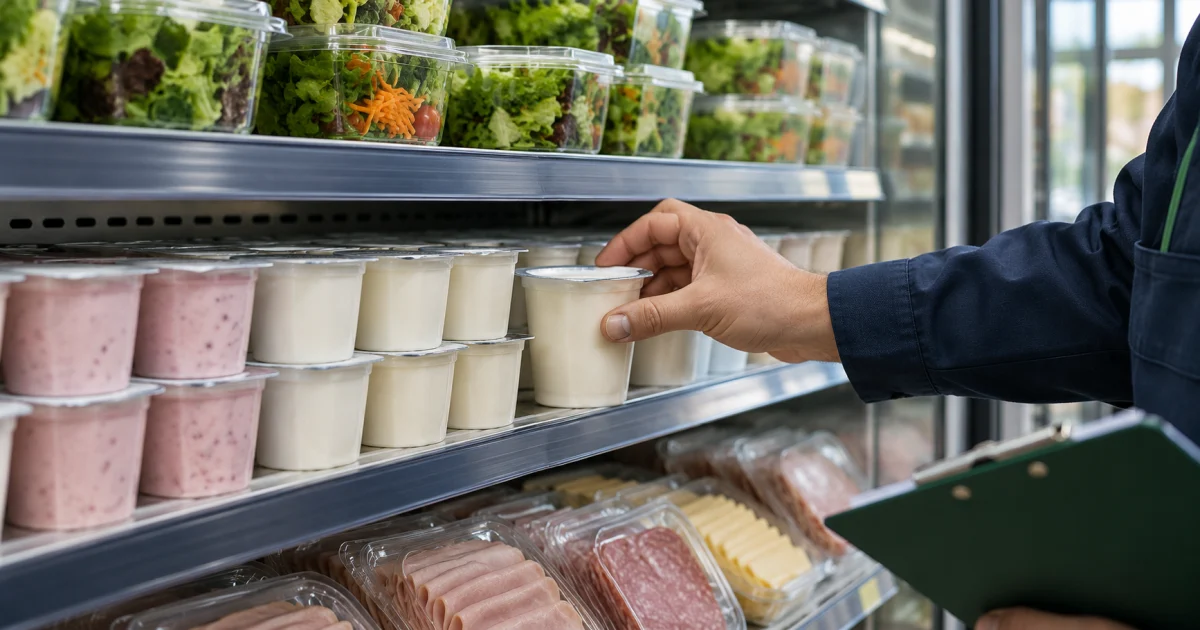
It is 6:40 in the morning. The chiller by the entrance holds four rows of yogurt, a shelf of ready salads and two trays of cooked ham. Somewhere in there, a few packs reach their date today. The person opening the store has twenty minutes to find them before the doors open.
This is where food waste in retail is decided, one pack at a time. A yogurt marked down a day early sells. A yogurt found two days late goes in the bin, and nobody records why. Multiply that by every chiller in a chain and every morning in a year.
Until now, that scene was a store matter. The EU has set binding national food waste targets for 2030, and one of them includes retail. That changes what store-level records are worth.
What Directive (EU) 2025/1892 sets for 2030
Directive (EU) 2025/1892 was adopted on 10 September 2025. It amends the Waste Framework Directive 2008/98/EC. It was published in the Official Journal on 26 September 2025 and entered into force on 16 October 2025. Member States must transpose it into national law by 17 June 2027.
The directive sets two binding national targets, to be reached by 31 December 2030:
- a 10% reduction of food waste in processing and manufacturing;
- a 30% reduction per capita, jointly in retail and other distribution of food, in restaurants and food services, and in households.
Both are measured against the annual average generated between 2021 and 2023. A Member State may use 2020 or an earlier year under conditions, and must notify an earlier year by 17 April 2027.
By 17 October 2027, the Commission adopts a tourism correction factor for the 30% target. By 31 December 2027, it reviews the 2030 targets, including possible binding targets for 2035.
Member States must also take measures so that certain food business operators offer donation agreements. These are operators that play a significant role in preventing food waste. The agreements go to food banks and other redistribution organisations, for unsold food that is safe to eat.
Food waste is measured by weight, under Commission Delegated Decision (EU) 2019/1597. What a retailer must report is set by national law.
Retail shares the 30% target with households and restaurants
There is no separate target for supermarkets. The 30% reduction is shared by retail, other food distribution, restaurants, food services and households, counted together per capita. The directive does not split it by sector.
Retailers can still face measures at store level under national laws aimed at the joint target. The transposition deadline is 17 June 2027. What a retailer must report depends on national law in each country.
A pack found two days before its date can still be marked down and sold. A pack found on its last day has fewer options. A chain that knows when and why packs leave its shelves can answer questions about its own waste with its own data.
FEFO on the shelf, not only in the warehouse
FEFO means first expired, first out. The pack with the nearest date is sold, marked down or removed first. Warehouses have worked this way for years, because pallets carry dates and systems track them.
The shelf is harder. Staff refill from the back, customers pick from the front, and some customers dig for the freshest pack. A single facing of milk can hold three dates. The date that matters for the store is the nearest one, because that pack expires first.
In a store, FEFO comes down to three habits. Put the nearest date to the front when refilling. Check the nearest date of each product on a regular walk. Act on that date before it passes: mark down first, then remove.
The weak point is memory. An experienced manager knows which salads turn fast. A new colleague on the early shift may not. Without a written date and a rule, the walk depends on who is on duty.
Once staff record the nearest date, they can use it to time the markdown and remove the pack on the right day. Later, the record also shows how many packs reached their date, and why.
What a store can record from tomorrow morning
A store does not need a new warehouse system to start. It needs a few records, kept the same way in every store.
- The nearest date per product: for most packs, staff type it once. If a GS1 DataMatrix carries the expiry date, the date can come from the code. The new app can also use the best-before date (AI 15) when AI 17 is absent.
- Markdowns by rule: a step per category, for example -25% two days before and -50% one day before. The rule decides, so the result does not depend on the shift.
- Removals with reason and time: quantity, reason (past date, damaged, other) and when it happened.
- Tasks done or open: whether the morning list was finished, and what was left.
These records answer simple questions. How many packs of yogurt reached their date last week? Which store removes the most ready salads, and on which day? Were markdowns done on time? Those answers come before any weight or emissions figure.
The new freshto-app records all of this today, in web and test builds. The product page shows how it works. If your suppliers have started putting expiry dates into 2D codes, GS1 DataMatrix expiry dates explains how the date is read and what happens when it is missing.
What Freshto records today and what is planned
Freshto has two apps. The current Android app is in use in stores today. It covers camera and hardware scanning, offline storage with a manual send step, best-before and production dates, assortment upload from a spreadsheet, an integration API and web reports for head office. The current legacy app does not read expiry dates from GS1 DataMatrix.
The new Freshto app reads EAN-13 barcodes and expiry dates from GS1 DataMatrix in native test builds. In the web version, staff can enter the encoded data in the Scan field. Store-published iOS and Android releases are planned for the next release, v0.2.
Available now in the new freshto-app:
- camera scanning of EAN/UPC and GS1 DataMatrix in native test builds, with manual, pasted or keyboard-scanner input in the Scan field on the web;
- date from a GS1 code with a product GTIN, using Application Identifier 17 for expiry or AI 15 for best before as a fallback;
- nearest-date entry from a numeric keypad, one nearest date per product;
- markdown rules per category with steps and store exceptions;
- a morning task list per store, ordered by section, each task with a reason;
- removals with quantity and reason;
- offline work with background upload and visible sync status;
- a store manager overview with a 7-day forecast.
Planned features:
- recording the outcome of each markdown as sold, donated to a food bank or written off;
- an ESG report on loss reduction, in kg of food and CO2e;
- markdown percentage recommendations from sales speed;
- multi-store head office reports and a catalogue import API with stock levels in the new app;
- reading the printed date on the pack with the camera, with a confirmation screen.
Today Freshto records dates, markdowns and removals with a reason. Tracking what happens to each marked-down pack and reporting food waste in kg are planned.
A 30-day pilot as a first measurement
The 2030 targets are national, and they compare with a past baseline. A chain’s own baseline starts on the day it begins to measure.
We run a 30-day pilot in one or two stores. We use a published method to measure time spent on expiry checks and write-offs before and after the pilot. The figures come from your own shelves.
Read how the pilot is measured, or book a 45-minute call to plan it with your store operations team.
Questions and answers
Does Directive (EU) 2025/1892 set a separate target for supermarkets?
No. The directive sets a 30% per capita reduction by 31 December 2030 that is shared jointly by retail and other food distribution, restaurants and food services, and households. There is no retail-only figure. The baseline is the annual average from 2021 to 2023. What each retailer must report is set by national law when the directive is transposed.
When do the EU food waste targets apply?
The targets must be reached by 31 December 2030. Directive (EU) 2025/1892 entered into force on 16 October 2025, and Member States must transpose it by 17 June 2027. The Commission adopts a tourism correction factor by 17 October 2027 and reviews the 2030 targets by 31 December 2027, including possible binding targets for 2035.
What is the difference between FIFO and FEFO in a store?
FIFO, first in, first out, sends the oldest delivery to the shelf first. FEFO, first expired, first out, uses the date on the pack instead. In a store the two often differ, because one delivery can carry several dates. For yogurt, ready salads or cooked ham, FEFO means the pack with the nearest date is sold, marked down or removed first.
Can Freshto produce an ESG or food waste report today?
No. An ESG report on loss reduction, in kg of food and CO2e, is planned and not available today. Recording whether each marked-down pack was sold, donated to a food bank or written off is also planned. Today the new freshto-app records nearest dates, markdowns by rule and removals with quantity and reason, which such a report would build on.
Sources
- Directive (EU) 2025/1892 amending Directive 2008/98/EC on waste, EUR-Lex, Official Journal of the European Union
- Directive 2008/98/EC on waste, consolidated text of 16 October 2025 (Article 9a), EUR-Lex
- Food waste reduction targets, European Commission, DG SANTE
- Commission Delegated Decision (EU) 2019/1597 on food waste measurement, EUR-Lex