Two ways to set markdown rules for short-dated food
Days to expiry or share of shelf life used: how each markdown rule works, where it breaks, and how to write a one-page freshness charter for every department.
- markdown rules
- shelf life
- freshness charter
- food waste
Why “discount it if it looks old” produces waste
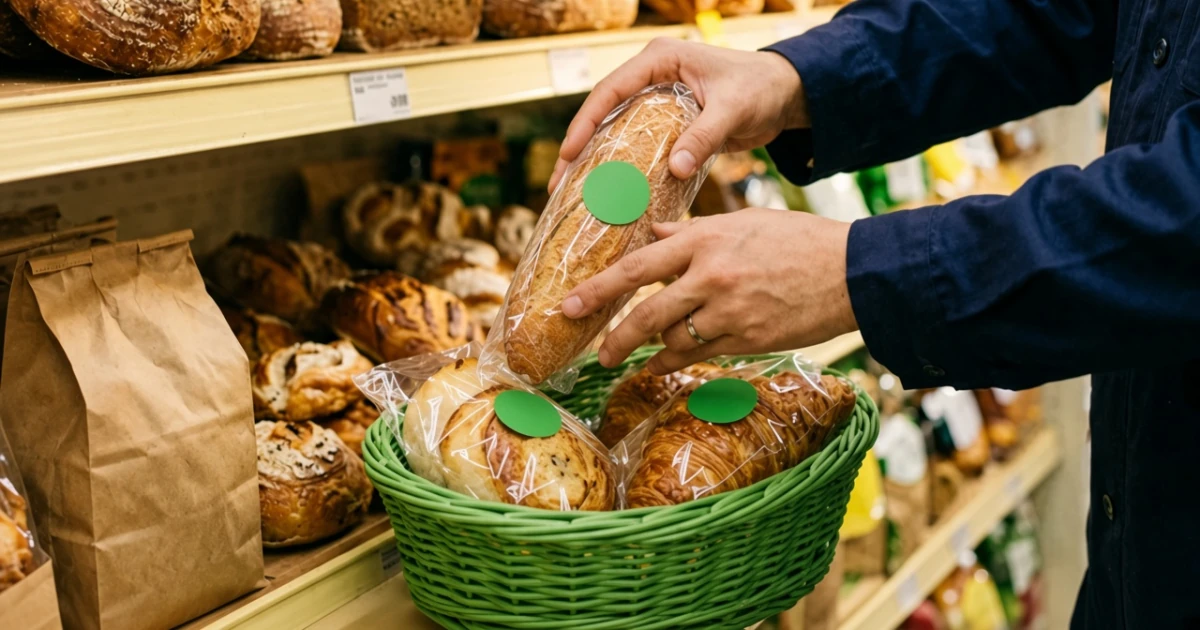
Almost every chain starts with an informal markdown rule: if it looks old, discount it. It sounds sensible and it fails in predictable ways. One store marks down the day before the date, another waits for the last day, a third never does. Shoppers find different prices on the same product in different stores of the same chain. Products near their date are left until it is too late to sell them, then written off. And the store with the most careful manager looks worst on margin, because it gives discounts while its neighbour writes off the whole product.
According to Eurostat, retail and other distribution of food accounted for 8% of EU food waste in 2024, below 5 million tonnes. That is a small share of a large problem, but it is the share where a written rule changes the outcome directly.
A markdown rule replaces the judgement call with a decision made once, calmly, by people who can see the whole category. There are two legitimate ways to write it.
Family one: days to expiry
The rule reads: mark down when N days are left. It is simple to say, simple to teach on the first day and simple to check. It works best in short-life departments such as fresh bakery, salads and chilled ready meals, where the whole life is a few days and one number fits almost everything.
The weak point is that N days means different things for different products. Take a three-day rule. On a product with a five-day life it fires after less than half of the life has gone, which is probably too early and gives margin away. On a product with a forty-day life it fires in the last stretch, which is probably too late to move the volume. Both numbers here are illustrations, not data. The point is that one fixed number stretches badly across mixed shelf lives.
Use days when the department is homogeneous. Do not use one number across a department that mixes short and long lives.
Family two: share of life used
The second rule reads: mark down when a given share of the labelled life has passed. The parameter below is an illustration only, not a statistic and not a recommendation. Say the rule is “first step when 70% of the labelled life has passed”. A product with a ten-day life reaches that point on day seven. A product with a forty-day life reaches it on day twenty-eight. The same sentence works for both, and nobody has to remember a table of exceptions.
The cost is data. A share-of-life rule needs the total life of each product, which means the date of production or the labelled life must be known, not just the date printed on the pack. It is also harder to explain at the shelf than “three days left”. On the date side, Freshto supports both a best-before date and a production date; for a production date, the shelf life is added to get the expiry date.
Use share of life where shelf lives are mixed: a department that holds both fresh yoghurt and long-life desserts, for example.
Multi-step markdowns and per-store exceptions
One step rarely does the job. A better pattern is a ladder: a smaller discount first, a deeper one later, and a clear last action at the end. For example, a first step at an early point to nudge the product, a second step deeper as the date closes in, and a final decision to pull or sell through. The numbers in your ladder belong to your margins and your customers, so test them in a couple of stores before they go into a charter.
Freshto supports multi-step markdown rules per category or per SKU, with per-store exceptions. The exceptions matter more than they look. A small store with low traffic may need to start the ladder earlier. A store near a commuter station may sell out of the morning bakery before noon and need nothing. Keep exceptions to a short list and write down why each one exists, otherwise they quietly turn back into the informal rule you started with.
Use-by and best-before are not the same
Regulation (EU) No 1169/2011 distinguishes the “use by” date from the date of minimum durability, usually shown as “best before”. After the “use by” date a food is deemed unsafe (Article 24). That ends the discussion for those products: the last step of the ladder is a pull, and it happens no later than the date.
A “best before” date is a statement about quality, not a safety cliff. Even so, the chain needs a written rule for what happens as it approaches and after it passes. Leave it to the individual and you are back to the informal rule. National enforcement can add store-level requirements, so the chain should follow the law of its own country and ask its food-safety lead. This article is not legal advice.
Does a markdown beat a write-off?
Usually, yes. A timely markdown recovers some value from a product that would otherwise become a cost twice: once as lost sales and again as disposal. A markdown that is too early gives away margin on a product that would have sold at full price. The art is the timing, and that is what the rule fixes. The calculator on this site lets you test how your own numbers behave: open the calculator and use your figures.
Put it on one page: the freshness charter
A charter does not need software. It needs one page, owned by the category or operations manager, that every store can read. An illustrative layout:
| Department | Rule family | Steps | Last action |
|---|---|---|---|
| Fresh bakery | Days to expiry | Small discount, then deeper discount | Pull at close of the last day |
| Dairy | Share of life | Small discount, then deeper discount | Pull at the date for use-by items |
| Meat | Days to expiry | Single early step | Pull at the date |
The table is an example of structure, not a recommendation. What matters is that each department has a family, a ladder and a last action, and that the person walking the aisle never has to invent any of them.
How it connects to the morning walk
A rule on paper does nothing until someone applies it at the shelf. The morning walk is where that happens: a short list, one person per task, one recorded action per item. The rule decides which action is correct, and the walk records it. If you have not set up the routine yet, start with how to run the morning FEFO walk.
With Freshto the rules sit with the category or SKU, the evening run builds the next day’s list, and staff record sell through, markdown, pull or not found against it. Printing the markdown sticker on a Bluetooth label printer is planned, not available today. Until then the store follows its current price-label process.
To see how rules, lists and reports fit together, read the product overview or try the demo. A chain operations team will also want the for-chains page.
Questions and answers
Which is better, a days-to-expiry rule or a share-of-life rule?
Days to expiry suits departments where the whole life is short, because one number fits every product. A share-of-life rule suits mixed shelf lives, because it scales with each product. Many chains use days in some departments and share in others.
Can a product be marked down after its use-by date?
No. Under Regulation (EU) No 1169/2011, after the use-by date a food is deemed unsafe (Article 24). It is pulled, not discounted. A best-before date works differently, but the chain still needs a written rule. This is not legal advice.
Can one store use different markdown rules from the rest of the chain?
Yes. Freshto supports multi-step markdown rules per category or SKU, with per-store exceptions, for example for a smaller store with lower traffic.
Does the app print markdown stickers?
Printed markdown stickers on a Bluetooth label printer are planned, not available today. Until then the store follows its current price-label process.